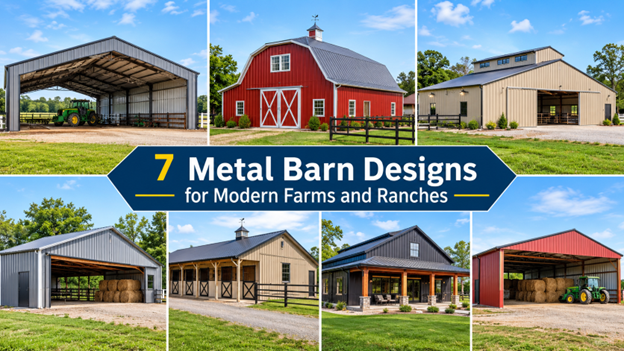
7 Metal Barn Designs for Modern Farms and Ranches
Barn structures will withstand adverse conditions for 20-30 years. So, the building doesn’t cost more if it has to be retrofitted later on. Most ranchers begin their search for livestock, hay, or equipment rentals with custom metal barns. This is because there are several advantages of making use of the structure. But there are several types of barns available, and you might get confused regarding which one is best.
To solve this problem, we have discussed the most common barn designs. Click down to see all of them, one by one.
1. Clear-Span Barn
A clear span barn has no columns to support the structure from the inside. None. The entire span of the building is open floor with no obstructions. Cattle can be run and big machines stored freely. More important than any square-footage figure given on a specification. You don’t have to worry about obstructing the turning radius of your tractor, and you don’t have to worry about the layout being obstructed.
This kind of barn is typically covered with steel trusses. They distribute the roof loading out to the side walls rather than down the center of the roof. Another 60 to 80-foot span can be obtained for quite a distance without encountering any obstacle. Provides sufficient spacing for most working alleys, squeeze chutes, or multiple rows of combines.
2. Gambrel-Roof Barn
Two-sided roof slopes as opposed to a single roof slope. It’s the one shape people can think of first, and then say “barn,” and it’s not just visual. The lower slope is steeper, with a flatter upper slope providing a true loft with headroom. Does not require a second building just for hay or for additional equipment.
They can be used on smaller lots too, and it’s a more usable volume in the same footprint. In addition, it’s steeply pitched, and it drains snow and rain quickly. That’s why it’s important to design it if you are anywhere that actually has winter. There’s one more thing: A gambrel barn looks as traditional on the road as the same barn with a steel siding.
3. Monitor-Style Barn
Think of one of these narrow strips of roof that is brought up from the level of the main roof and stretched lengthwise all across the barn. It also features vents or small windows that are added in. The result is air circulation, with hot air rising and blowing out of those vents. Aids livestock areas to stay cooler during the summer without the constant use of a fan.
Many dairy farmers and horse owners turn to this design often; that is why it is ideal. It lets in natural light down the center aisle. It reduces the need for the barn for artificial lighting during daylight hours. It adds a bit of framing, though. This is because of that raised feature linking to the main roof. That’s why a lot of builders have performed plenty of these. It is a routine, not a custom, design. However, it’s always important to inquire about that when you’re comparing quotes.
4. Lean-To Combo Barn
Use a smaller structure with only a single slope; add one on the side of a larger barn. You have a second enclosed area without an additional building. The lean-to side is frequently utilized on ranches as a car parking area. At this covered work area, they work with farm animals or hay and other farming activities while the main barn works with animals or hay.
So, if you require a structure and have two jobs, you can do it under one structure. This space is typically less expensive than adding a new space for a new purpose. The biggest benefit is that you can keep feed and equipment closer to access them whenever you need. When both the tractor and bales are close, you don’t have to walk across the yard to get bales in the tractor.
5. Multi-Stall Horse Barn
There are a few areas that need to be dedicated, such as a wash rack, tack room and a little office where you can control and manage things from. Make sure the width of the aisle is correct for the entire building on the farm. This is the most common place to use, but if it’s not enough, it can be a nuisance. If you’re leading a horse, and a parked wheelbarrow is within 12 feet, it is already starting to feel cramped. It is important to pay attention to multi-stall barns as compared to a simple storage barn.
6. Barndominium-Style Barn
A “barndominium” is a type of house built in a barn. This one can be used by people to live and to do ranching and farming. It is split by an interior wall, but it’s not visible from outside. For families that are involved in ranching and farming, they can remain near the farms and the livestock without having to separate into different buildings.
It’s important to control insulation and moisture in your steel barn. Use the correct insulation; ask the building manufacturer to do this. In addition, have accurate information about HVAC and vapor barrier during construction, as this will be costly if done later.
7. Hay Barn and Open-Bay Equipment
They feature spacious bays, elevation doors, and a roof that will support stacked hay Barn. In this structure, there is no need for stalls, no insulation, and no need for finished walls. Low construction cost and maintenance. Determine the size necessary for your open bay barn if you have the equipment and total number of bales you intend to store.
Choosing The Correct Design for Your Operation
All of the above barn styles on the list are suitable for a rancher/farmer. The answer, however, depends on a number of factors which determine which one suits your needs exactly. Analyze and map out how you will use a structure, then think of storage needs, and others before selecting a barn building.
Any job that costs the most will do; it can be livestock comfort, hay storage or equipment protection. Furthermore, it is important to choose a reliable metal barn building dealer to erect a farm building, but talk to their specialists about your requirements thoroughly. A gambrel roof on one builder and a clear span on another builder gives no indication of each house’s value.
When comparing like with like, it’s much easier to figure out which design will provide the most space for the lowest price.